
Massaged Kale Salad with Pear and Pumpkin Seeds
Have you guys tried massaged kale salads yet? Just over a year ago, I made my first one. It was the first time I had ever even eaten kale. Since that first massaged kale salad, we’ve been eating them a LOT. You can throw almost anything in a kale salad and it’s going to be good. And the best part is that once the kale salad is dressed, it doesn’t get all soggy and nasty like a dressed lettuce salad.
This massaged kale salad with pear and pumpkin seeds has been packed in my lunch box regularly for the past couple of weeks. I get a big bag of kale on Sunday and whip out 5 salads, one for each day of the week. I love the crunch from the pear and the subtle aroma of the nutmeg in the salad. (Also, I prefer to use red pears, but when I just put pears on the list, Hubby grabbed the ones in the photos. Any kind of pear will work here)
One Year Ago: Pumpkin Cranberry Pecan Upside Down Cake
Two Years Ago: Thanksgiving Two-Fer Bars
Three Years Ago: Outrageous Oreo Crunch Brownies and Peanut Butter Sandwich Cookies
Four Years Ago: Potato Pancakes with Cran-Applesauce and Potato Bread (my FIRST time using yeast!)
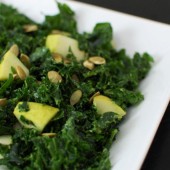
Massaged Kale Salad with Pear and Pumpkin Seeds
Yield: Serves 5-6
Ingredients:
1 large (16 oz) bag Kale
3-4 Tbsp extra virgin olive oil
1 Tbsp lemon juice
1 ripe avocado
1/2 tsp salt
1/2 tsp freshly ground nutmeg
5 Tbsp pepitas (pumpkin seeds)
2 red pears, chopped
Directions:
In large serving bowl, add the kale, lemon juice, and olive oil (start with just 3 Tbsp, add the last if you need it). Massage until the kale starts to soften and wilt, 2 to 3 minutes.
Add the avocado and continue to massage with your hands.
Season with salt and nutmeg. Taste kale and reseason if necessary.
Mix in the pumpkin seeds and pears. Serve or store in the refrigerator up to 5 days.
Recipe from Beantown Baker




I am Jen the Beantown Baker. Engineer by day and baking maven by night. Hubby serves as my #1 fan and official taste tester. We got hitched back in 2006. Barefoot. In the sand. With the waves crashing behind us. It was one of the best decisions we’ve ever made. 

I’m guessing you’ve tried Manchego? It’s my favorite sheep’s milk cheese.
I’m lactose intolerant too, and cheese is what I miss most. I’m curious about the goat cheese and sheep’s milk cheese; according to what I’ve read, goats’ milk and sheep’s milk have almost the same amount of lactose as cows’ milk. How is it that the cheese doesn’t have lactose? I’d be interested in any resources you could pass on because I’d love to be able to eat some cheese again!
I’m lactose-tolerant, but according to a Good Eats episode on cheese, most of the lactose is removed during the cheese making process, so that’s why most lactose-intolerant people can eat it. My g/f is Asian and very lactose-intolerant, but she can eat cheese with no problem. Ice cream (which she will eat when she gets the craving) does her no good at all, but cheese is usually fine.
That’s interesting. I know lactose intolerance is different for each person. Unfortunately for me, eating cheese (and ice cream) is like a death-wish, but I have read that cheese that’s made traditionally, aged 2 yrs., has nearly no lactose in it. That’s hard to find though. I haven’t heard that goat cheese and sheep cheese have less lactose. But perhaps most goat and sheep cheese are aged?
I actually have the GE episode on my TiVo (Cheese: Good Milk Gone Bad) and he says that cheeses that have a little age on them have had their lactose consumed by the bacteria so there’s little if any lactose left. I just replayed that portion for the exactish quote.
I think goat/sheep cheese is similar to cow in that it can be fresh or aged. I think Manchego has fresh and aged varieties. If you have a good cheese source nearby, you should be able to find well-aged (2+ years) varieties of cheddar at the very least. A Canadian, English, Irish, or Austrailian. All are very good.
I truly feel sorry for you, as I love a nice extra sharp cheddar, Parma Reggiano, etc.
And really, it’s not my intention to torture you. 🙂
Thanks for looking that up for me! I’ll have to test the waters the next time I’m feeling brave…:) I would LOVE it if I could eat some cheese again!
The only reason I eat goat and sheep milk cheese is because when my doctor told me I was LI, she said I could eat those. So that’s what I’ve been doing. I am very sensative to all cow dairy, but haven’t ever had problems with the goat or sheep cheese…
I haven’t tried Machego… I’ll have to look for it.
I first had Manchego at a tapas place near Phoenix on a cheese and fruit plate. I had no idea what I was missing. 🙂
oh my gosh! a fellow cheese junkie! haha
So I’ve been lactose intolerant since I went away to college… but I still enjoy most of my favorites. Lactaid works wonders!!! I carry the pills around with me all the time and enjoy most of the foods I love. Regarding the different milks, goats milk does indeed have lactose, it is just less than traditional cows milk so more people can tolerate it. I’m sure different processes in which you make cheese, etc could effect it, and everyone’s sensitivity is different as well. I adjusted quickly to Lactaid milk, and they have cottage cheese, ice cream (but i stick to the good ol’ stuff), and some other products I have yet to try. I urge fellow LI folks not to give up your (and my!!) favorite foods!!!
I found this website of sheeps cheese and it appears it is good for people with LI.
http://www.sheepscheese.com/
Yep! Sheep cheese is my friend for sure.
I am severely lactose intolerant but love food and cooking, so this has been a difficult adjustment for me as well. Parmigiana Reggiano is lactose free as well as; Grana Padano, all Finlandia cheeses including Muenster and Lappi. I use Lappi as a substitute for Mozzarella as it has similar texture and flavour. Muenster has worked well as a substitute for many cheeses as it has great flavour. There are some cheeses that I cannot tolerate such as mozzarella. Goat cheese does have lactose, but also has a protein in it that is different from that in cow’s milk. This makes it much more easily digestible and is great for those with lactose intolerance. Hope this is helpful! p.s. – I make my own ice cream by making creme anglaise with lactose free 2% milk.